 Foilopedia
Safety · Rules, law and environment
E-foil propeller safety, launching and landing
Every foil has sharp wings. An e-foil adds a spinning propeller under the water, and that is the hazard to respect most. Hobbywing, which makes e-foil drive systems, tells riders never to touch the propeller in the water.1
The fix is a set of simple habits. Do them the same way every session, until they are automatic. Falling technique for your first ride is in your first e-foil ride. The general foiling basics are in foil safety.
Treat the board as live
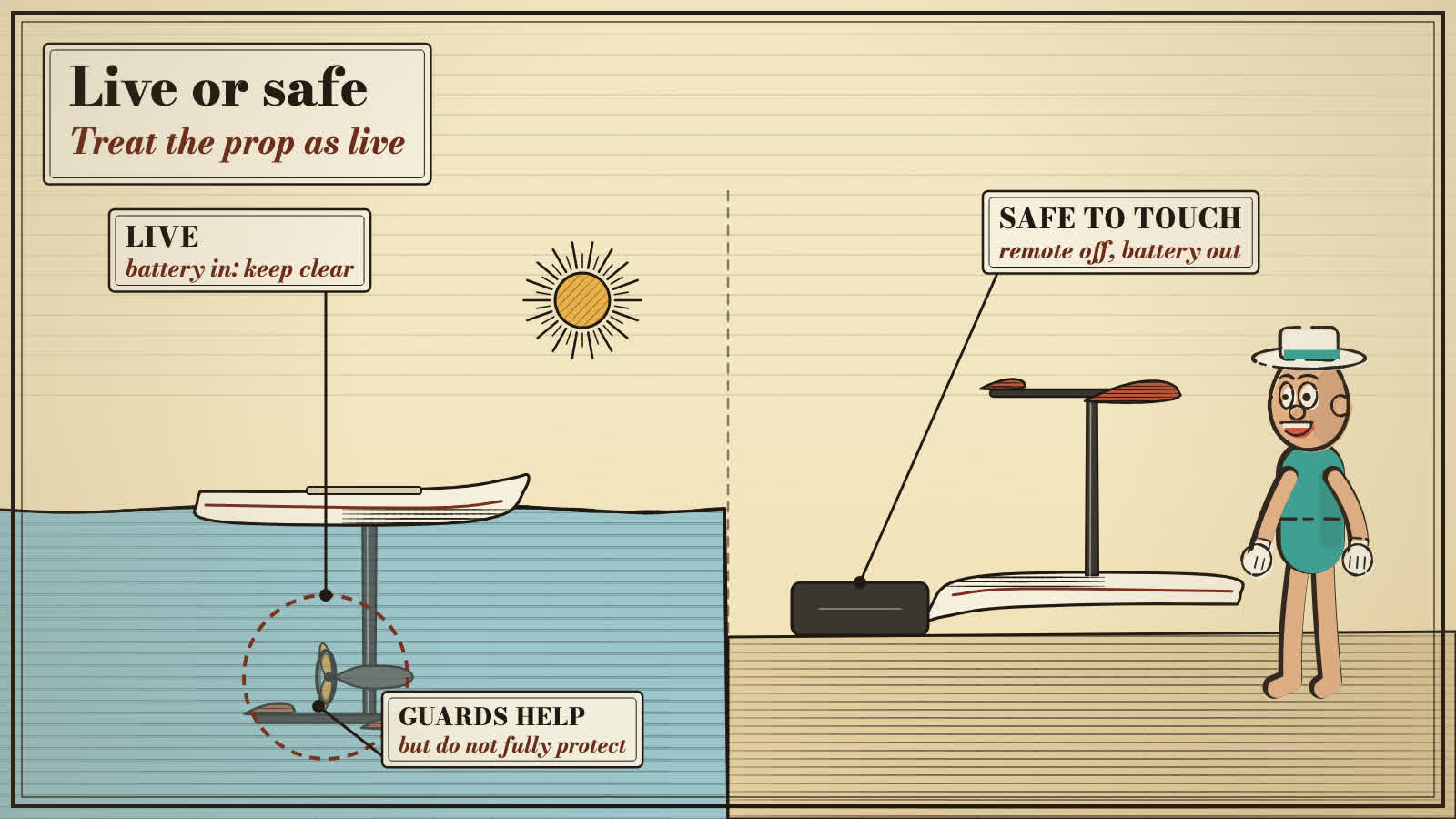
Think of two states: live and safe. Live means the battery is in and the remote is on. Safe means the system is off, and for any hands-on work, the power is disconnected.
- Hands off the propeller when it is powered. Hobbywing says to keep your body, fingers and toes away from the propeller whenever the system is on or in the water.1
- Never touch the propeller in the water. Hobbywing says not to try to grab or hold it there.1
- Disconnect the power before you work on it. Hobbywing says to disconnect the power before servicing the propeller. Clearing weed or checking a nick counts.1
- Keep it disarmed near people. Waydoo says to keep the system disarmed during transport and whenever anyone is near the propulsion unit.2
- Wear the wrist strap. If your remote has one, put it on, so a dropped remote stays with you.
Beginner tip: say it out loud at first: "remote off, battery out" before your hands go near the mast.
How the board helps you
Most e-foils have safety cut-offs. They back up your habits. They don't replace them.
- Release to stop. Waydoo says releasing the remote's trigger stops the motor.3
- Arming step. Fliteboard says its motor only engages after a set sequence on the remote, and it goes back to standby if you don't use the trigger for five seconds.4
- Tilt cut-off. Fliteboard says a sensor cuts the motor if the board tips past a set angle or flips over.4
- Signal cut-off. Fliteboard says the motor shuts down if the remote goes out of range or goes under water.4
Every brand does this differently. Learn exactly how your own board arms, disarms and cuts out from its manual.
Prop guards and jets
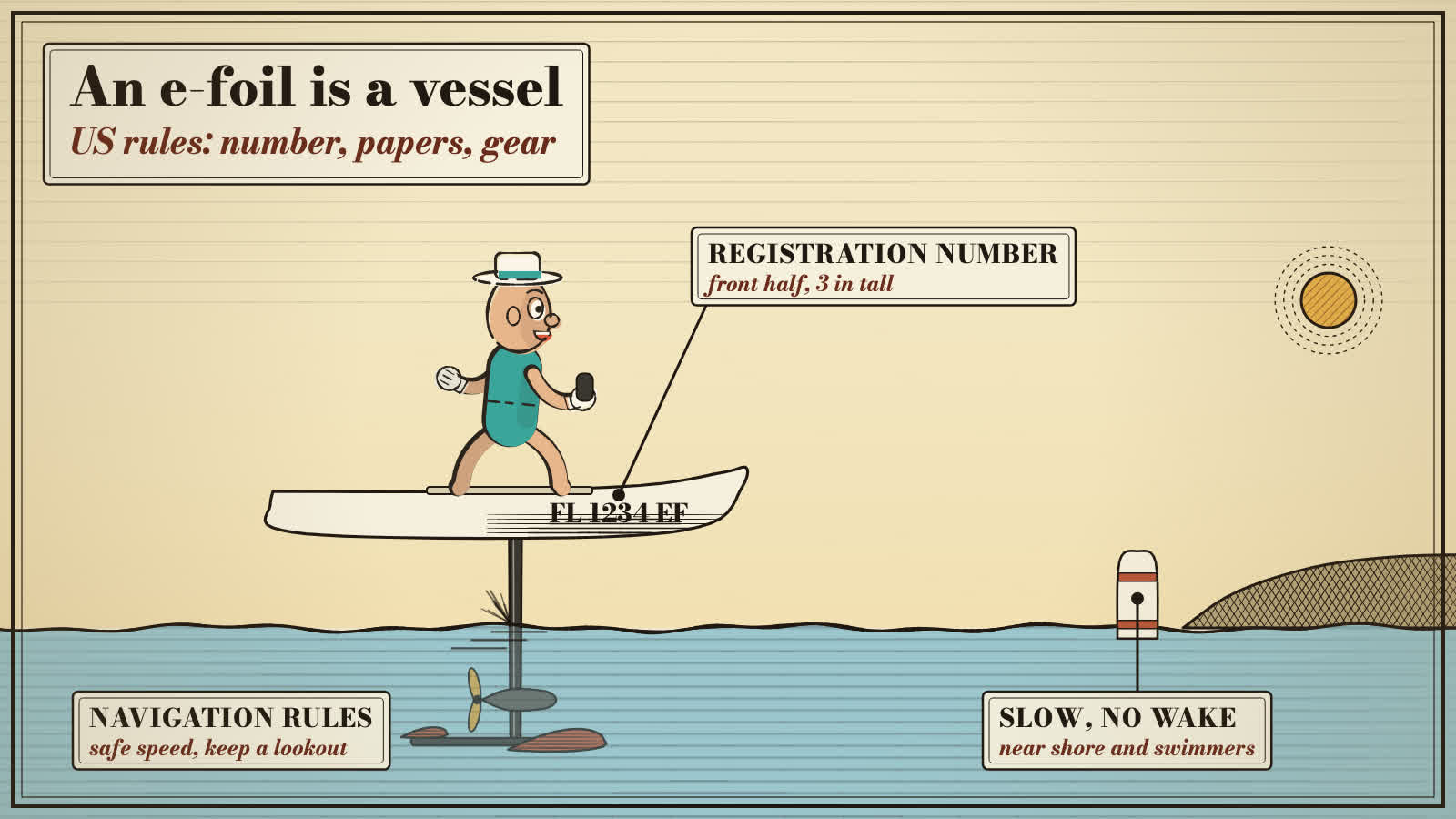
A guard puts a cage around the propeller. It helps, but it is not a shield. Duotone says its own ePropeller Guard (made for its Foil Assist Cruise mast) "does not fully protect" against the spinning propeller.5
Fliteboard offers a removable propeller guard and a jet drive with an enclosed impeller. It also says its propellers are designed to break on impact. Even with a guard or jet, keep the same live-or-safe habits. What a jet costs you in thrust and ride time is in how to choose an e-foil.4
Carrying to the water
- Lock the remote first. MACkite's Waydoo safety guide says to lock the hand controller before you take the board into the water.6
- Carry it with one hand on the handle, one on the fuselage. MACkite says to hold the side handle with one hand and the fuselage with the other, with the mast behind you.6
- Point the foil away from people. Waydoo says to keep the foil on the offshore side so it doesn't swing toward anyone.2
- Walk the route first. Look for rocks, shallow sandbars, docks and moorings before you carry the board.2
For lifting and carrying without hurting your back, see traveling with an e-foil.
Launching
Walk out beside the board, not behind it, until the water is deep enough. MACkite says to set the board in upside down and flip it once you reach depth.6
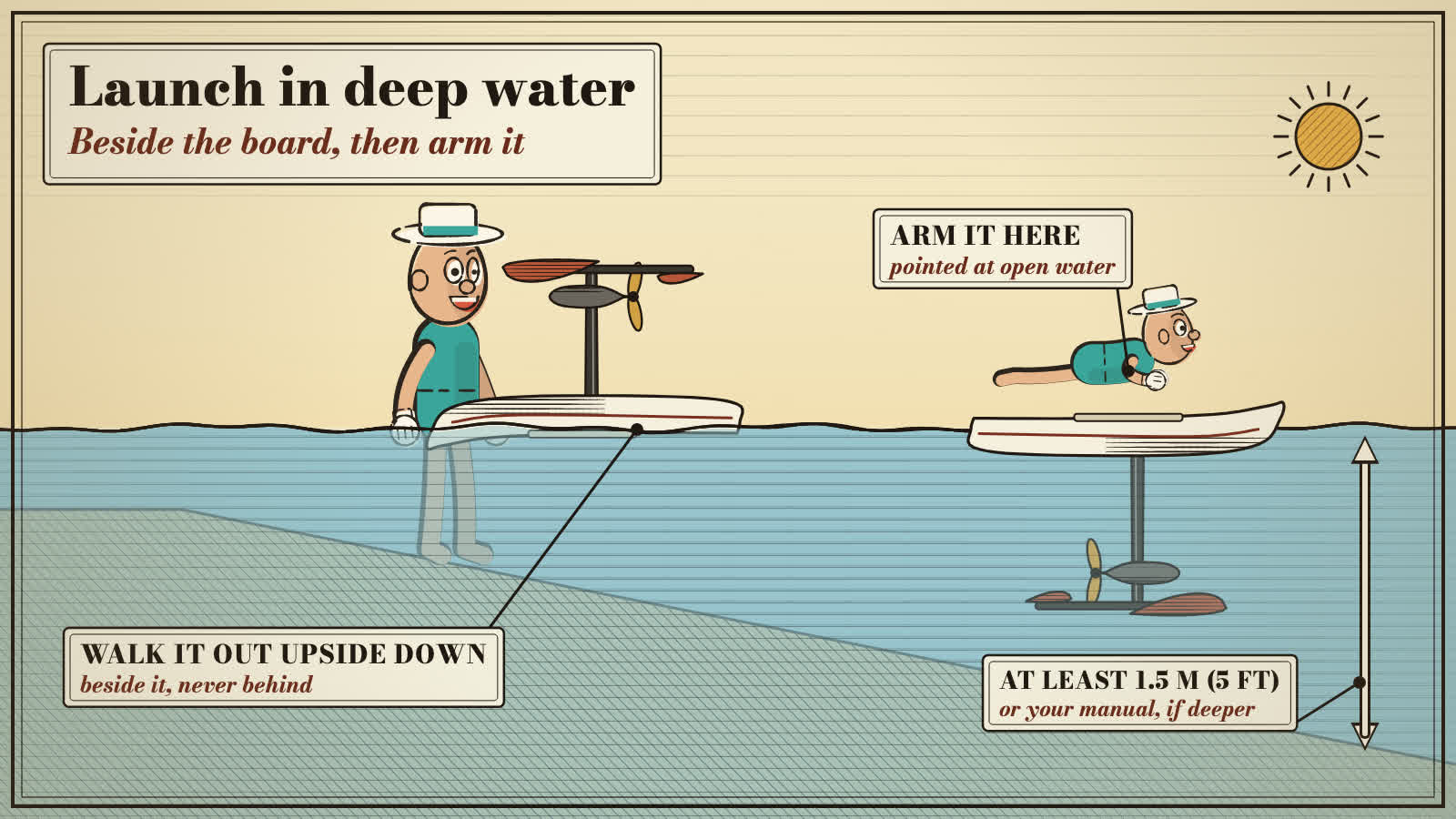
How deep is deep enough? Use at least 1.5 m (5 ft), or your manual's figure if it is deeper. In waves, add at least the height of the waves, because the trough is shallower.7
The makers don't all give the same figure:
- Fliteboard: at least 1.5 m (5 ft).7
- MACkite, for Waydoo: more than 2 m (6.5 ft).6
- Hobbywing: at least 5 m (16 ft) in the riding area.1
Waydoo's rule of thumb: the water must clear the whole mast and foil through waves, turns and falls, with a generous margin beyond the maker's minimum. Never run the motor where the foil or propeller could hit bottom.2
Arm the system only once you are in that depth, with the board pointed at open water.2
Landing
Landing is when you are most tired and the bottom is closest, so slow everything down.
- Come off the foil early, while you are still in deep water. Settle the board onto the surface.
- Disarm and power down before you get near the shore.2
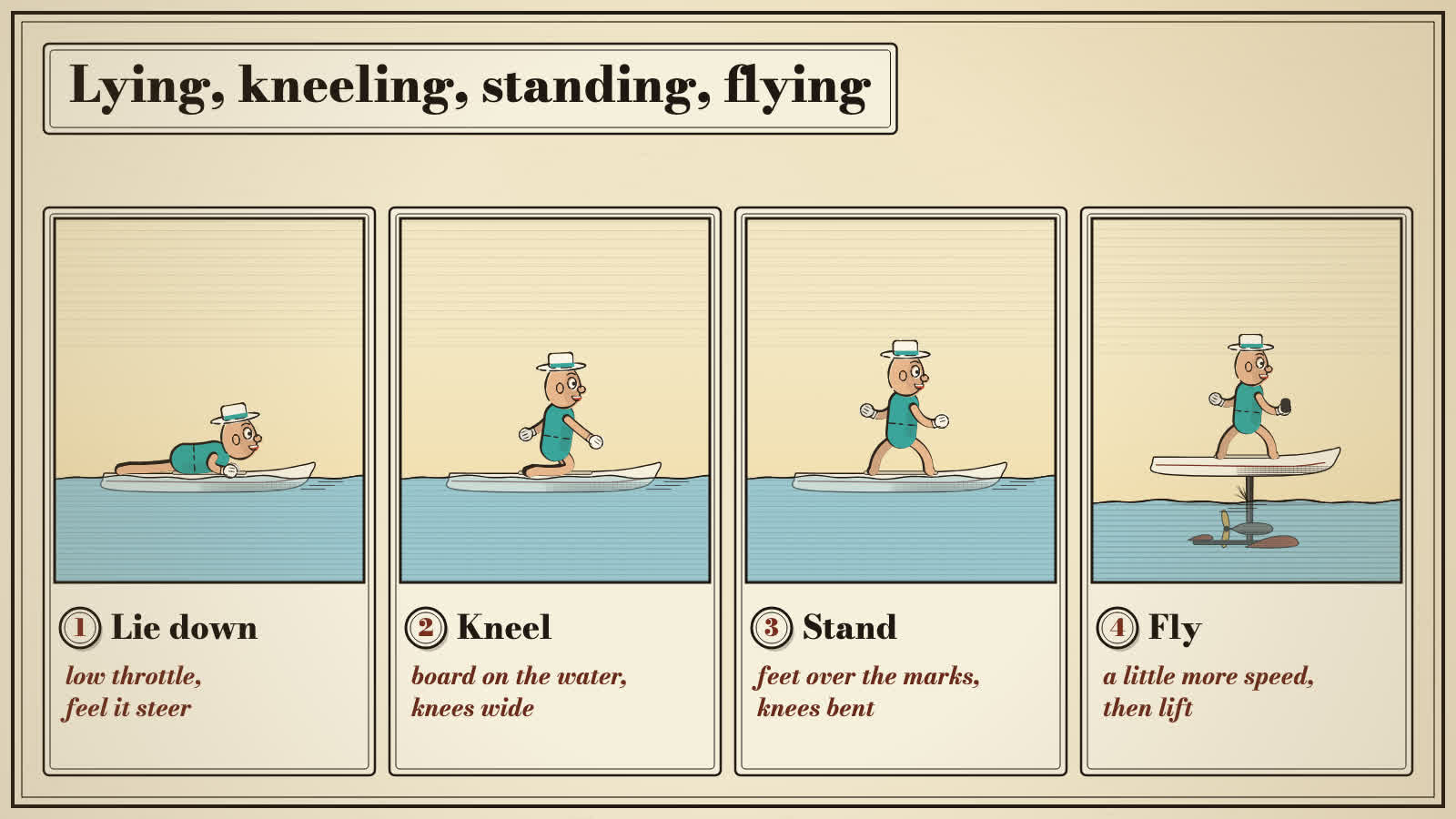
- Lie down and paddle in until you can stand. Then slide off to the side away from the mast, and roll the board on its side or flip it foil-up before the foil touches bottom.
- Never fly into the beach. The foil hangs well below the board and will hit bottom long before you do.
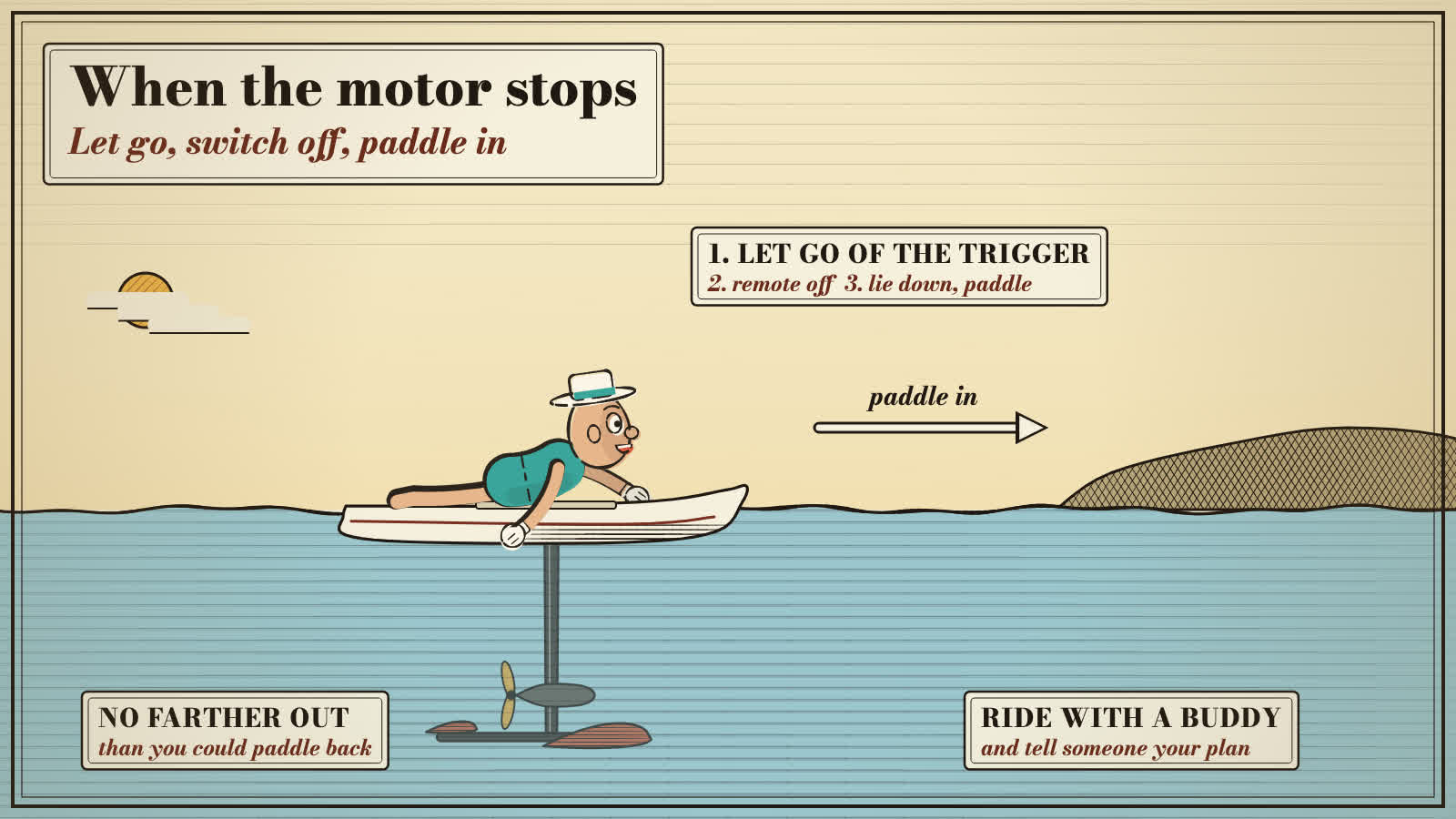
If the motor stops far out instead, see when something goes wrong on an e-foil.
Docks. Waydoo lists docks, moorings and sandbars as hazards to avoid. If you must start or finish at a dock, learn the method from an instructor first.2
Other people in the water
- Give swimmers room. MACkite says to stay at least 100 m (330 ft) from swimmers. Local rules can set their own distances. See e-foil rules.6
- Check the area is clear of swimmers and divers before you ride.1
- Keep helpers back. Waydoo says to approach the board only once the system is disarmed. That goes for a friend wading over to help, too.2
- Passengers and kids. Check your manual before anyone else rides on the board. Never hand an armed remote to someone else.
FAQ
Can an e-foil propeller hurt you?
Yes. That is why every maker builds in cut-offs and tells you to keep hands and feet away from a powered propeller. Treat the board as live until the remote is off and the power is disconnected.1
Does a prop guard make an e-foil safe?
It helps, but it doesn't fully protect you. Duotone says its own propeller guard does not fully protect against the spinning propeller, so keep the same habits with a guard fitted.5
What happens if you fall off an e-foil?
On most boards, letting go of the trigger stops the motor. Some, like Fliteboard, also cut out if the board tips over or the remote goes out of range. Still, approach the board only once it is disarmed.4,2
How deep should the water be to launch an e-foil?
At least 1.5 m (5 ft), or your manual's figure if it is deeper. Fliteboard says 1.5 m, MACkite says more than 2 m for Waydoo, and Hobbywing asks for at least 5 m (16 ft) in the riding area.7,6,1
Keep learning
Sources
Facts checked against the sources below in November 2026.
- Hobbywing, Precautions sports.hobbywing.com ↩
- Waydoo, How to eFoil waydoo.com ↩
- Waydoo, FAQs waydoo.com ↩
- Fliteboard, eFoil safety: how Fliteboard is designed for safer riding fliteboard.com ↩
- Duotone, ePropeller Guard Cruise duotonesports.com ↩
- MACkite, eFoil safety tips while riding your Waydoo mackiteboarding.com ↩
- Fliteboard, How to eFoil: a step-by-step guide fliteboard.com ↩