 Foilopedia
Safety · Rules, law and environment
Is an e-foil a boat? The rules, place by place
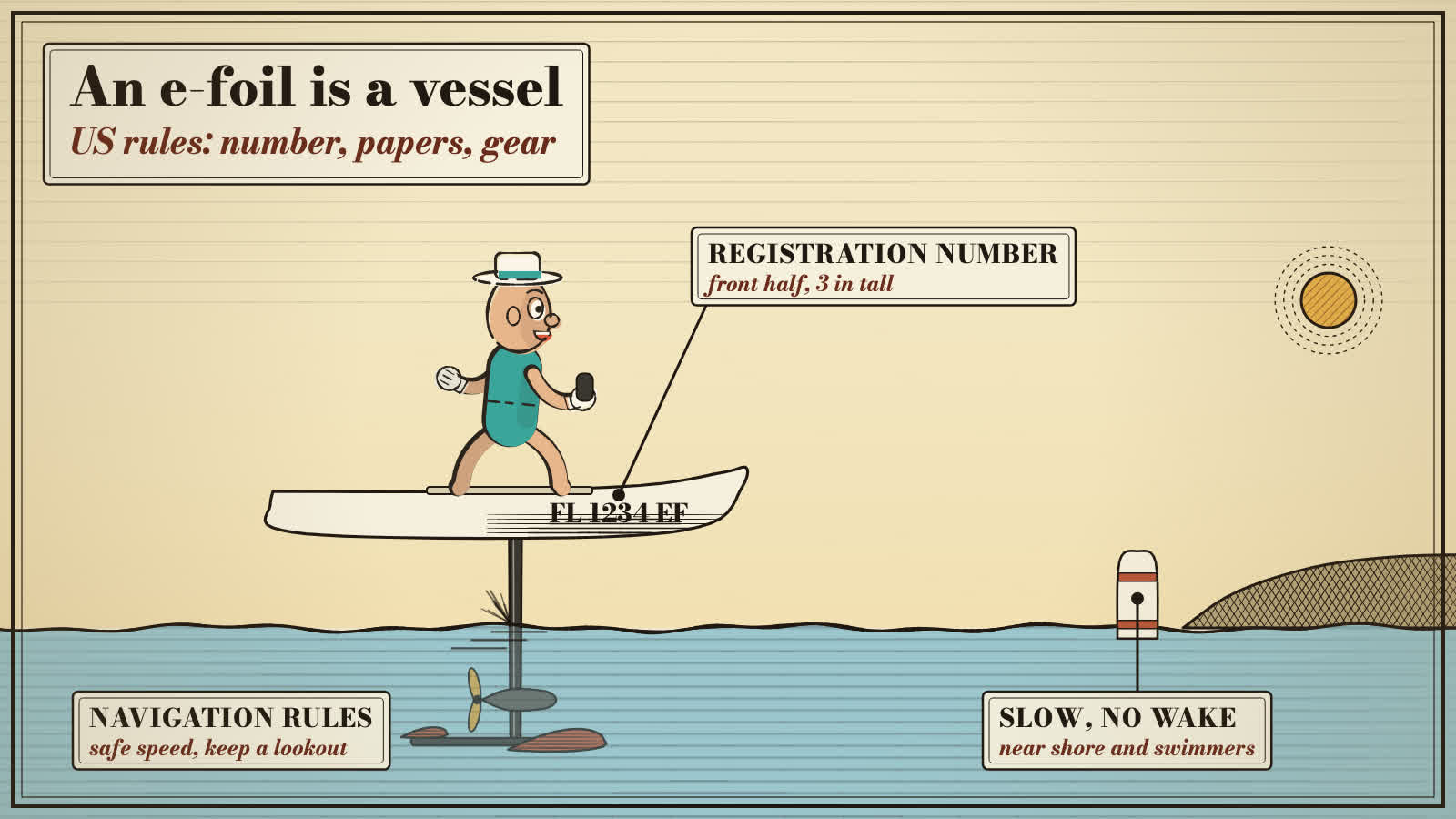
In the United States, an e-foil is a boat in the eyes of the law. The US Coast Guard calls it a mechanically propelled personal hydrofoil and says it is a vessel, so the laws for motorboats apply to it.1
That surprises a lot of new owners. Use this as a starting point, not legal advice.
What the US Coast Guard says
The Coast Guard set out its view in Policy Letter 22-02, Change 1, dated October 5, 2022. It replaced an earlier letter, 01-22, from August 2022.1
It notes that these boards can go faster than 35 mph (56 km/h), and that normal boat rules don't always fit a flat board with no steering wheel.1
The letter says owners and riders should:1
- Have a HIN. The board needs a verified Hull Identification Number (HIN) before a state can number it.
- Register with your state. The state where you mainly ride issues a certificate of number.
- Show the number. On the front half of the deck, in block letters at least 3 in (7.6 cm) tall, in a color that contrasts with the board.
- Carry the certificate whenever you are underway.
- Carry or wear a life jacket (PFD) as your state and federal rules require.
- Carry a sound-producing device, such as a whistle (when to use it: e-foil emergencies).
- Follow the Inland Navigation Rules, including proper lights if you ride at night or in poor visibility.
- Use the engine cut-off switch if your board has one installed.
One big caveat. The letter says plainly that it is guidance, not a rule, and does not itself create legally binding requirements. Your state turns this into actual law, and states differ.1
Beginner tip: if you only ride at a school or on a rental, the operator usually handles registration. Ask them. Once you own a board, it is on you.
Two US examples
Florida
Florida's motor vehicle agency (FLHSMV) told its offices in Technical Advisory RSTL22-028, dated September 13, 2022, that e-foils must be titled and registered with the state. It also asks for a HIN and a manufacturer's statement or certificate of origin.2
Hawaii
Hawaii's Division of Boating and Ocean Recreation (DOBOR) has a page just for e-foils, last updated March 12, 2025. It says:3
- An e-foil is a motorized vessel that must be registered if it is rated at 5 hp (about 3.7 kW) or more.
- It is not a personal watercraft (jet ski).
- Within 200 ft (61 m) of any shoreline, surfer or swimmer, you must keep to slow-no-wake speed, generally no more than 5 mph. That matters if you ride swell near a break: see e-foiling in waves.
- A boating safety course is required at 10 hp (about 7.5 kW) or more, and recommended below that.
- Boards with a foil assist motor, such as Foil Drive (what an assist is), are regulated the same way as e-foils.
Other states may treat e-foils differently. Check with your state's boating agency before you register or ride.
Sharing the water
Whatever your state says about paperwork, the Coast Guard expects you to follow the navigation rules. Two of them matter most on an e-foil.1
- Keep a lookout. Rule 5 says every vessel must keep a proper lookout by sight and hearing at all times.4
- Ride at a safe speed. Rule 6 says every vessel must go at a speed that lets it stop in time. What counts as safe depends on visibility, traffic, wind, waves, current and hazards nearby.5
On a busy beach that means slowing right down near swimmers, paddlers and surfers, even where no speed limit is posted. For habits that keep the propeller away from people, see e-foil propeller safety.
Outside the US: a few examples
These are examples, not a full list. Every country, state and harbor can set its own rules.
Canada
Canada's Small Vessel Regulations say no person shall operate a propeller-driven surfboard-type vessel (section 1006). The online text was current to November 12, 2026. Transport Canada says these vessels are currently prohibited. Its 2022 consultation proposed safety rules that would apply only if the ban is lifted. Its page was updated September 23, 2026.6,7
Neither page names e-foils directly, and neither says how jet-driven boards are treated. If you plan to ride in Canada, ask Transport Canada first.
New South Wales, Australia
The NSW Government classes motor-powered hydrofoil boards as personal watercraft, with some exemptions. As of November 2026 its page says:8
- The exemptions stop applying above 25 knots.
- Boards with motors over 4.0 kW need registration.
- You need a boat license at 10 knots or more.
- You must wear a life jacket, and not ride between sunset and sunrise.
- They are not allowed in the Sydney Harbour personal watercraft exclusion zone without a specific exemption.
Western Australia
The WA Department of Transport says electric hydrofoil boards with motors over 4.5 kW (6 hp) are vessels. Its page, updated August 25, 2025, says you need to register the board, hold a Recreational Skipper's Ticket and ride only between sunrise and sunset. You must also wear at least a Level 50 lifejacket, and carry more safety gear the farther out you go.9
UK, Europe and elsewhere
In the UK, France and elsewhere, rules are often set locally by harbor, lake and coastal authorities. Ask the harbor master, lake authority or local boating office for the water you plan to ride.
Who to check with
- US: your state boating agency, and for federal questions the Coast Guard Boating Safety Division.
- Canada: Transport Canada.
- Australia: the state maritime agency, such as Transport for NSW or WA's Department of Transport.
- Everywhere: the harbor master, park or lake authority, and the school or rental shop that rides there every day.
Ask three things: does my board need registration, what safety gear must I carry, and are there areas or hours where I can't ride?
FAQ
Do you need to register an e-foil?
In the US, very likely. The Coast Guard treats e-foils as vessels and says the state where you mainly ride issues a certificate of number. Florida requires title and registration, and Hawaii requires registration at 5 hp or more. Check your state.1,2,3
Is an e-foil a personal watercraft?
It depends where you are. Hawaii says it is not a personal watercraft. NSW in Australia classes it as one, with exemptions.3,8
Do you need a life jacket on an e-foil?
The Coast Guard says to carry or wear one as your state and federal rules require. Some places, such as NSW and Western Australia, require you to wear one. Check your local rules.1,8,9
Are e-foils legal in Canada?
Canada's Small Vessel Regulations ban propeller-driven surfboard-type vessels. As of November 2026, Transport Canada says they are currently prohibited. Its 2022 consultation proposed safety rules that would apply only if the ban is lifted. Ask Transport Canada about your board before you ride.6,7
Keep learning
Sources
Rules checked against the official sources below in November 2026. Rules change, so confirm with your local authority before you ride.
- US Coast Guard, CG-BSX Policy Letter 22-02, CH-1 (October 5, 2022) uscgboating.org ↩
- Florida FLHSMV, Technical Advisory RSTL22-028 (September 13, 2022) flhsmv.gov ↩
- Hawaii DLNR DOBOR, E-Foils and Foil Drive (updated March 12, 2025) dlnr.hawaii.gov ↩
- 33 CFR 83.05, Look-out (Rule 5) law.cornell.edu ↩
- 33 CFR 83.06, Safe speed (Rule 6) law.cornell.edu ↩
- Justice Canada, Small Vessel Regulations SOR/2010-91, section 1006 laws-lois.justice.gc.ca ↩
- Transport Canada, What we heard: Propeller-driven surfboard-type vessels tc.canada.ca ↩
- NSW Government, Motor-powered hydrofoil board nsw.gov.au ↩
- WA Department of Transport, Electric hydrofoil (updated August 25, 2025) transport.wa.gov.au ↩
Also used:
- US Coast Guard, CG-BSX Policy Letter 01-22 (August 26, 2022, replaced by 22-02 CH-1): https://www.uscgboating.org/library/regulations/BSX-Policy-Letter-01-22-eFoils-and-JetBoards.pdf