 Foilopedia
Level 1 · Start here
How a hydrofoil works, part by part
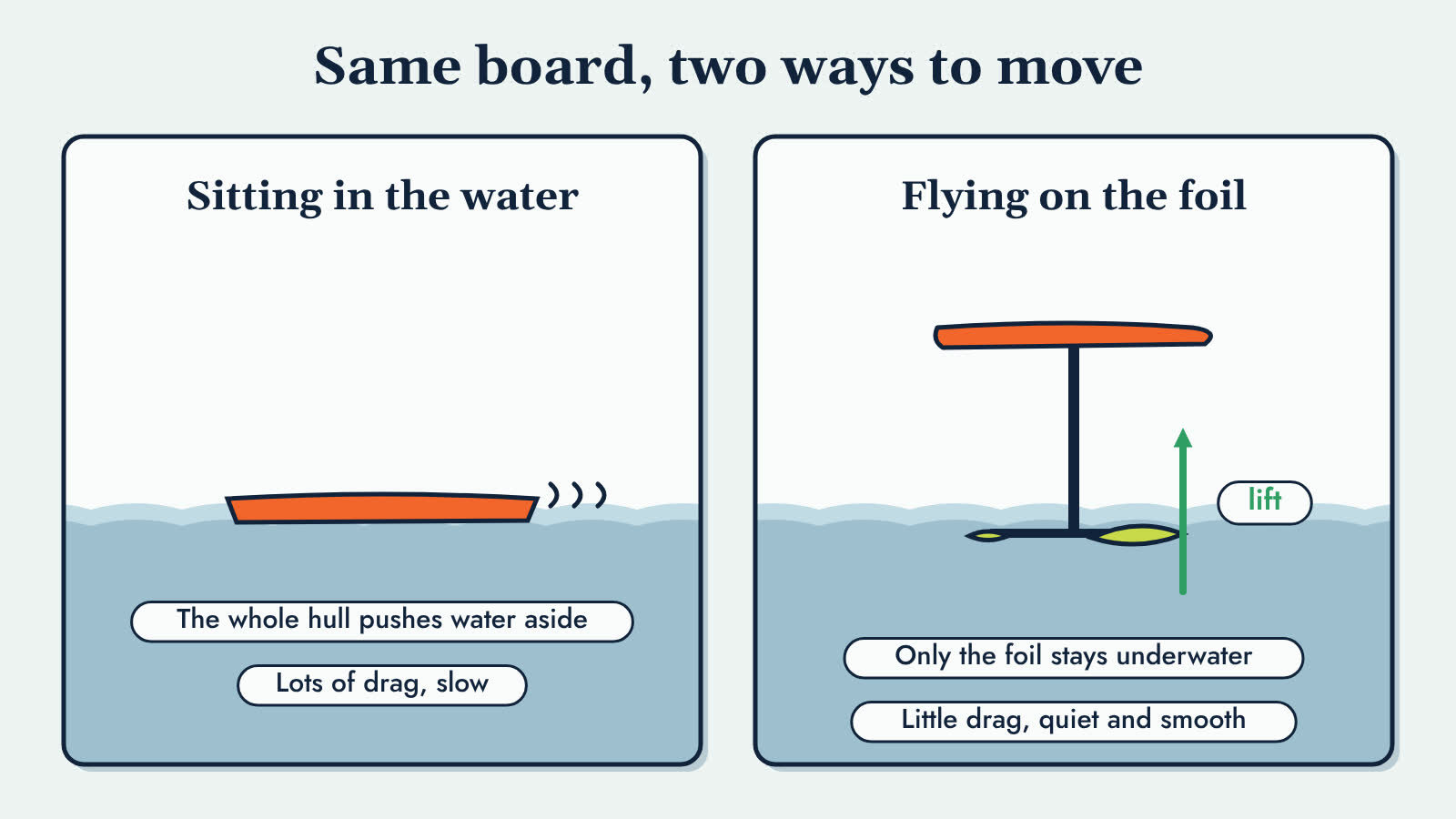
A hydrofoil works like an airplane wing, only in water. As the board moves, water flows over the curved front wing and creates a difference in pressure that pushes the wing up. Go fast enough and that push lifts the whole board out of the water, leaving only the mast and the foil underneath.1
Because water is far denser than air, a wing no wider than your arms can carry your full weight. Every part of the foil exists either to make that lift or to keep it smooth and controllable.
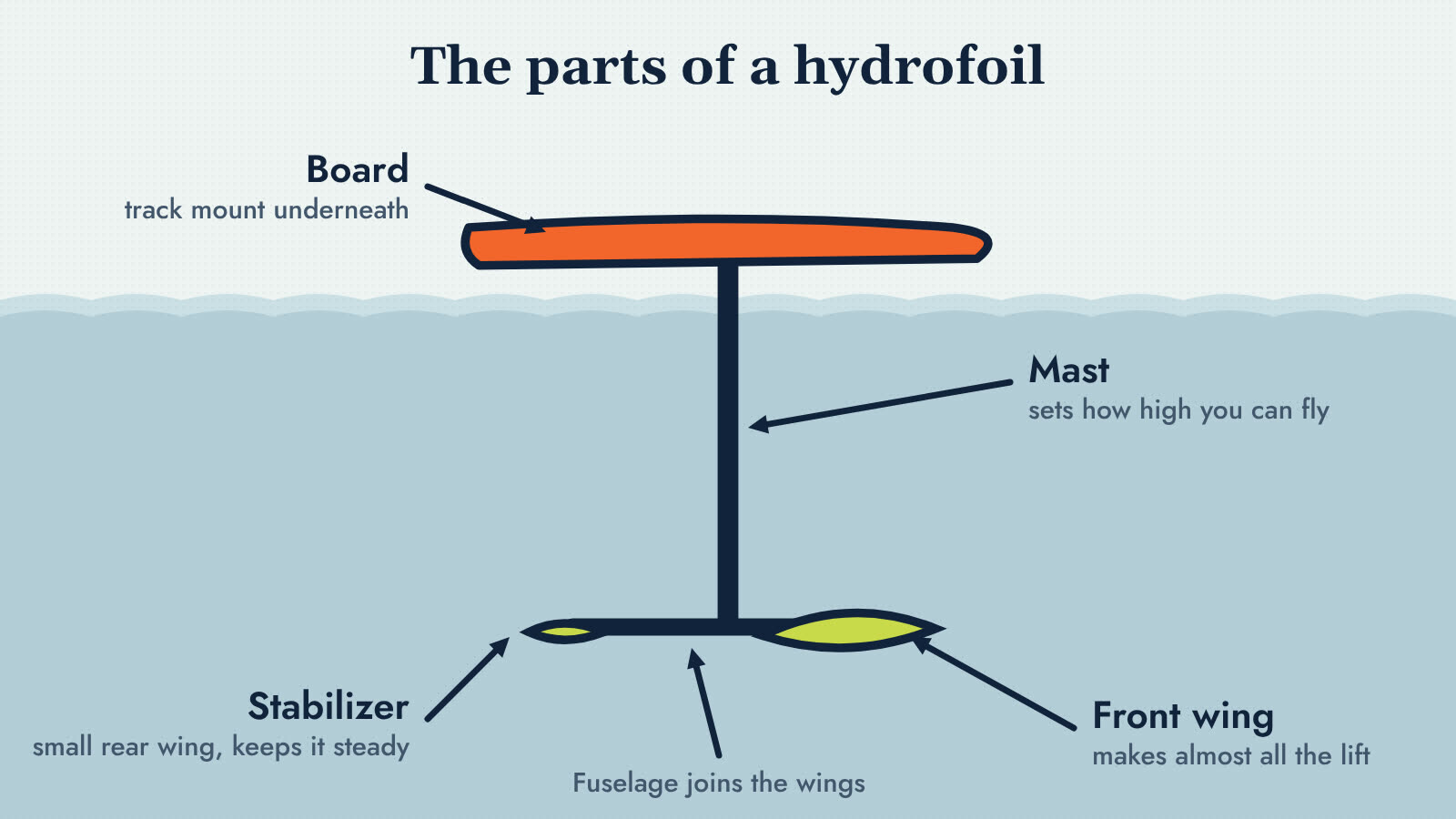
The five parts
Front wing
The front wing makes almost all of the lift, and it decides how the foil feels: how early it lifts, how far it glides, how fast it goes and how easily it turns. If you only remember one part, remember this one.1
Mast
The mast is the tall strut between the board and the wings. It sets how high you can fly before the wing breaks the surface. A stiffer mast passes your movements to the foil with less flex, so it feels more precise.1
Fuselage
The fuselage is the bar that joins the front wing to the rear wing. A longer fuselage feels more stable and forgiving; a shorter one turns quicker.2
Stabilizer
The stabilizer is the small rear wing. It keeps the front wing from pitching and rolling around and adds a little lift of its own. A bigger stabilizer feels planted and predictable; a smaller one turns tighter. You can change it without changing the front wing to tune how the foil feels.1,3
Board and mount
The mast bolts into a track under the board, so you can slide it forward or back. More board volume and length make takeoff easier, especially in light wind, for heavier riders and while learning.1
Front wing size: why bigger is easier
Front wings are sold by area, in square centimeters. A bigger wing lifts earlier and at lower speed, which suits light wind, heavier riders and beginners. A smaller wing is faster and looser, and suits strong wind and experienced riders.1
For wing foiling, beginner front wings often sit around 1,700 to 2,200 cm², depending on your weight and experience, and riders step down as they improve.4
Beginner tip: too small a wing is the most common way to make learning harder than it needs to be. A wing that lifts at a slow, calm speed gives you time to feel what is happening.
Aspect ratio: long and thin, or short and deep
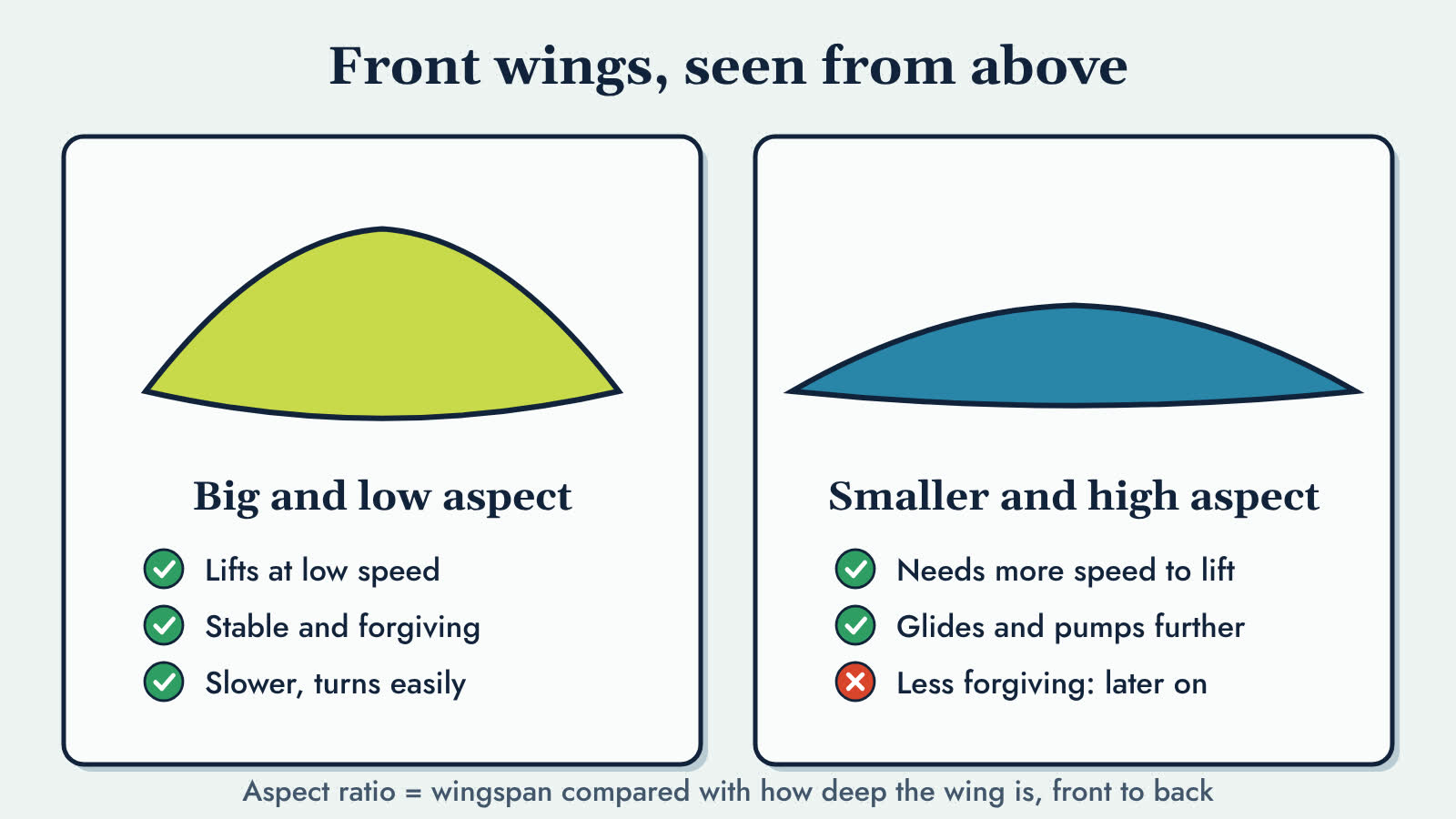
Aspect ratio compares a wing's span with its depth from front to back. A high-aspect wing is long and thin: it glides further, holds speed and pumps well, which suits distance, light wind and downwind riding. A lower-aspect wing is shorter and deeper and turns tighter, which suits carving.1
High-aspect wings are fast but harder to get flying; low-aspect wings take off easily and forgive mistakes. That is why beginners usually start with a larger, lower-aspect wing and move toward smaller, higher-aspect wings later.5,3
Mast length: start short
Masts run from about 45 cm to 110 cm. Shorter masts are easier to learn on and give gentler falls, but the wing breaks the surface more easily. Longer masts clear chop and swell but are harder to control. Riders usually start short and move longer as they improve.2,3
How you control height
Once you are flying, you steer the height with your feet. More weight on the front foot drops the nose and the foil sinks; more weight on the back foot raises the nose and the foil climbs. Change one thing at a time and keep the movements small.6
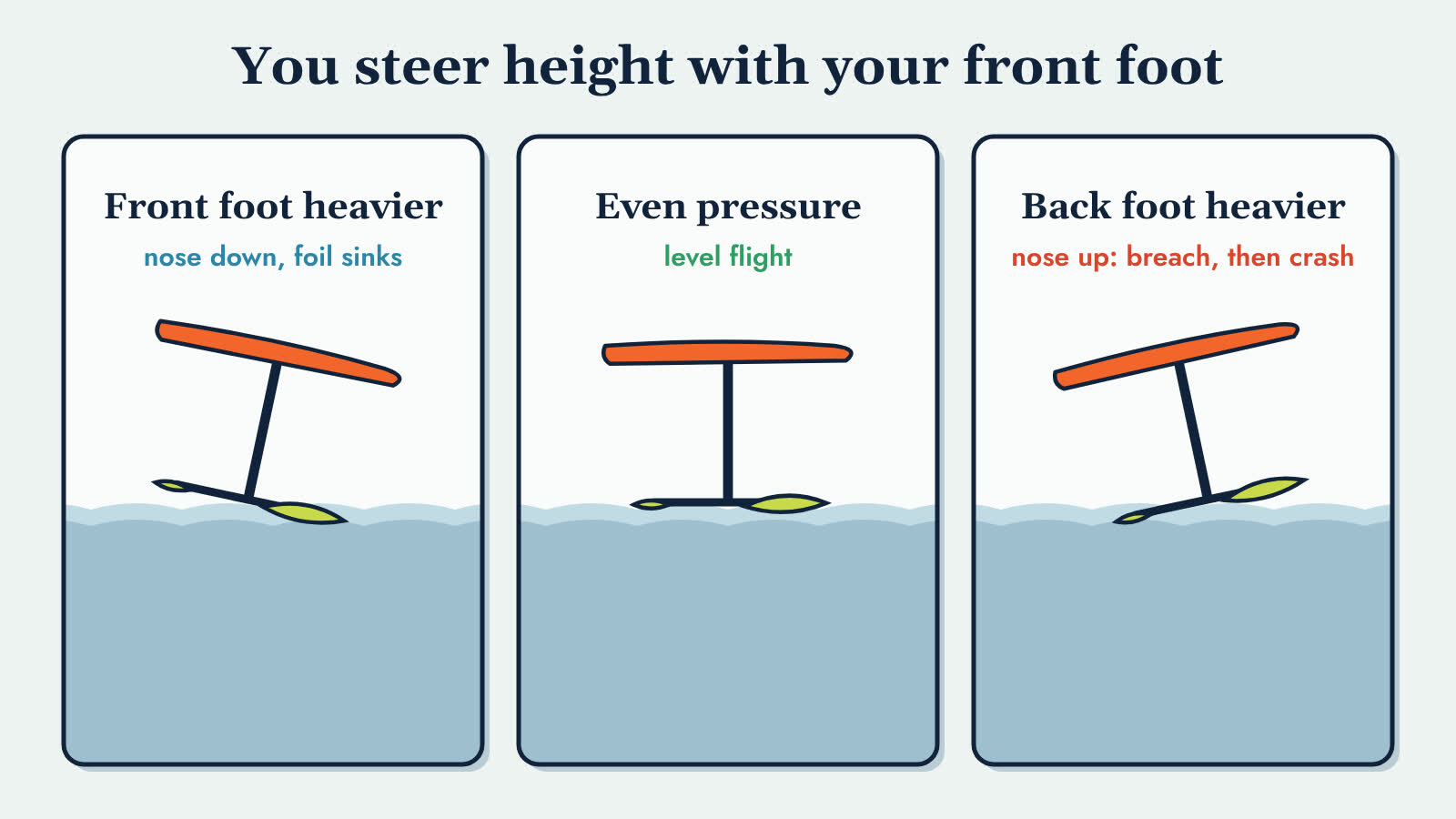
If the nose climbs too far, the front wing reaches the surface, loses its grip on the water and the board drops. Riders call this a breach. It is the most common fall in the first sessions, and the fix is almost always a little more front foot, earlier.
Common mistakes
- Leaning back to take off. Let speed lift the foil, then hold it level with small shifts of weight.6
- Mast too far forward in the track. The board is hard to lift and the nose wants to bury. Too far back, it lifts steeply and stalls. Start in the middle and adjust in small steps.7
- Buying the fast foil first. A small, high-aspect wing in the first season usually means fewer flights, not faster progress.
FAQ
What part of a hydrofoil creates lift?
The front wing makes almost all of it. The stabilizer adds a little and mainly keeps the foil steady.1
What size front wing should a beginner use?
Big enough to lift at low speed. For wing foiling that is often around 1,700 to 2,200 cm², with heavier riders at the upper end. Ask your school or shop for the size that matches your weight.4
What does aspect ratio mean on a foil?
How long and thin the wing is: its span compared with its depth. High aspect glides and pumps well but needs more speed and skill; low aspect lifts easily and turns tight.1
Why does my foil keep breaching?
You are flying too high, usually from too much back-foot weight. Move a little weight to your front foot before the nose climbs, and keep the movements small.
Keep learning
Sources
Facts checked against the sources below in November 2026.
- Cabrinha, How to choose the right foil cabrinha.com ↩
- Real Watersports, Anatomy of a foil realwatersports.com ↩
- Slingshot Sports, How to understand and choose a hydrofoil slingshotsports.com ↩
- Poole Harbour Watersports, What size wing foil kit do I need pooleharbour.co.uk ↩
- SURF magazine, Foil basics: terms, foil types and equipment surf-magazin.de ↩
- Waydoo, How to eFoil waydoo.com ↩
- Slingshot Sports, A beginner's guide to wing foiling slingshotsports.com ↩