 Foilopedia
Gear · E-foils and motors
Traveling with an e-foil: carrying, driving and flying
An e-foil is heavy and its battery is regulated cargo. Getting it to the beach takes some care. Getting it onto a plane mostly means leaving the battery behind and finding another one at the other end. For what the battery does, see e-foiling.
How heavy it is
A complete Fliteboard weighs 18 to 34 kg (40 to 75 lb), depending on board, battery and wing. Board build changes the total: see hard or inflatable.1
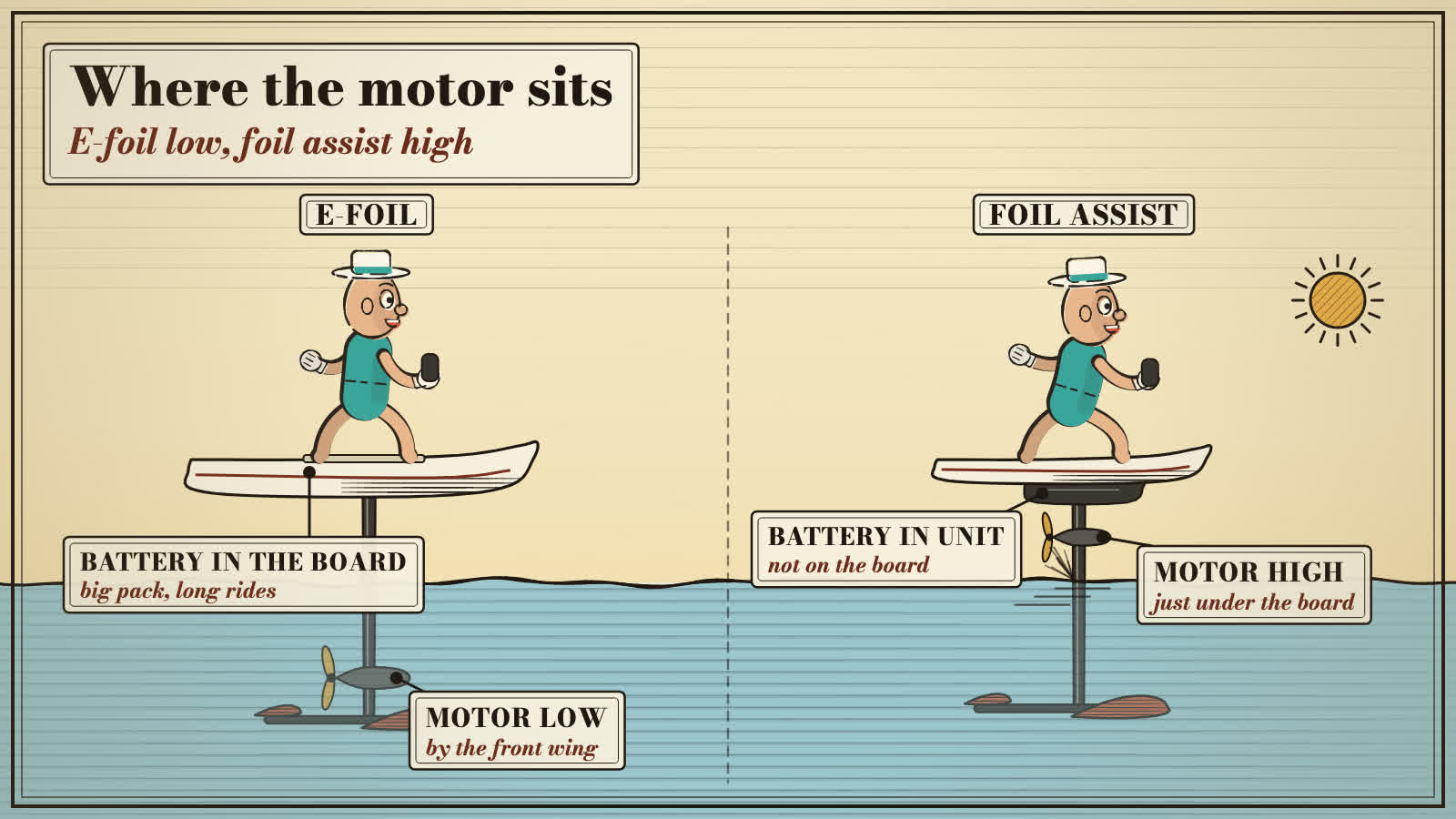
Foil assist batteries are much lighter. MACkite puts Foil Drive's MAX Power battery at about 5.8 lb (2.6 kg) and its Sport battery at about 4 lb (1.8 kg). For what an assist is, see e-foil vs foil assist.2
Carrying it to the water
Fliteboard suggests these habits:3
- Break it down. Disconnect the battery and keep it in a protective case. Unscrew the wing from the mast and the mast from the board.
- Use padded bags. Look for extra padding at the edges of the board and mast, where dings happen.
- Lift with a partner when you can, especially the built board. Alone, use a light cart or dolly.
- Keep it close. Hold the board close to your body with your back straight.
- Build it at the shore. Put it together at the water's edge, then carry it by the handle with the mast, or with the mast on your shoulder, standing up slowly.
Lock the remote before you carry the board. See e-foil propeller safety.
Beginner tip: walk the battery and the board down as two trips. Two light carries beat one heavy one on sand.
In the car
- Fit it in. In a small car, fold the rear seats and stack the parts with the battery secure and separate. A van or pickup can often take the built board.3
- Wedge the battery. Put it somewhere it can't shift while you drive. Don't let parts shift or get crushed under heavy items.3,4
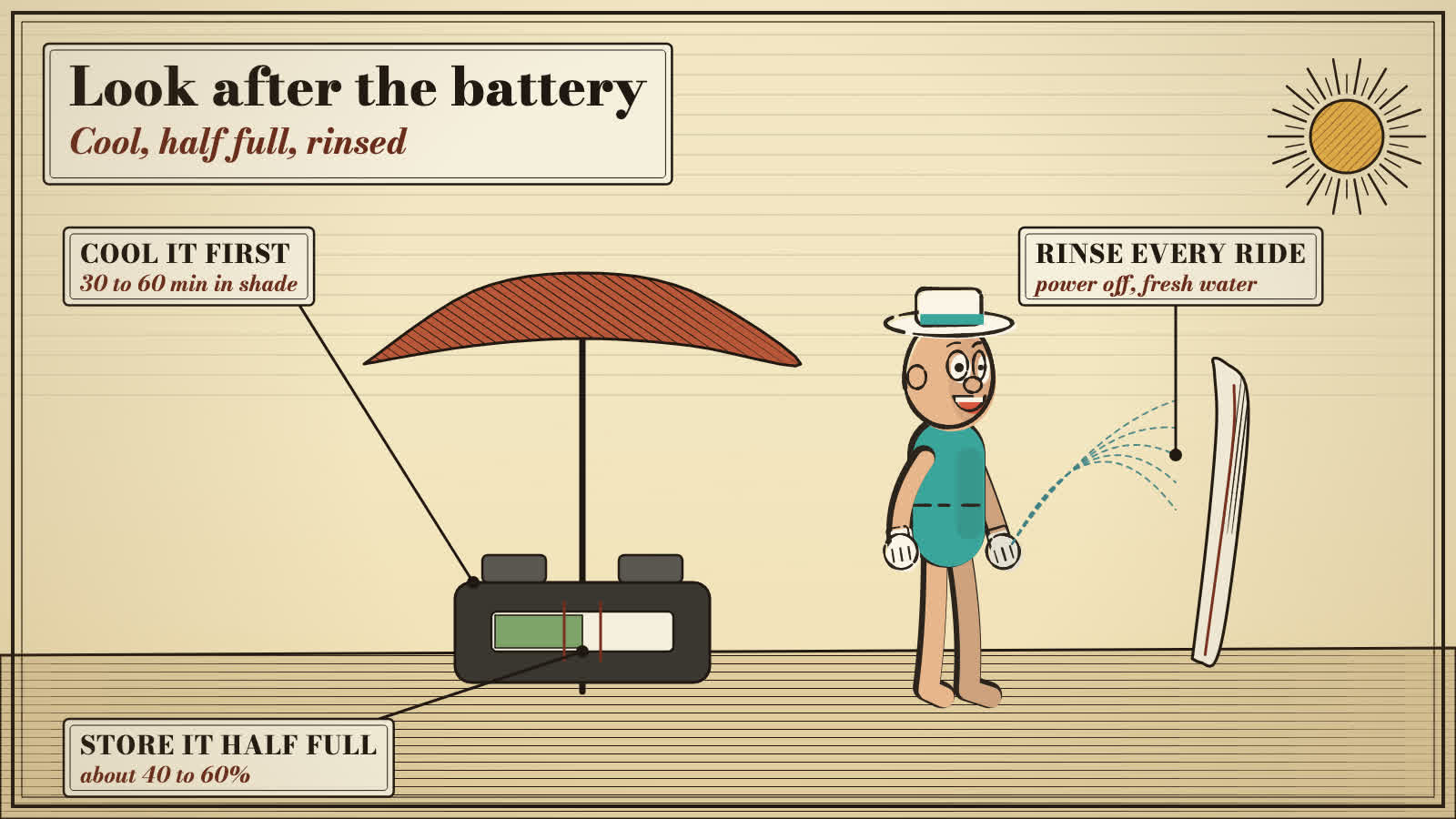
- Mind the heat. Keep the battery out of direct sun. Lift says not to leave it in a parked car, because the heat can damage it.3,4
- Pack it dry. Rinse and dry everything before you pack it. The full routine is in e-foil battery care.4
Why the battery can't fly with you
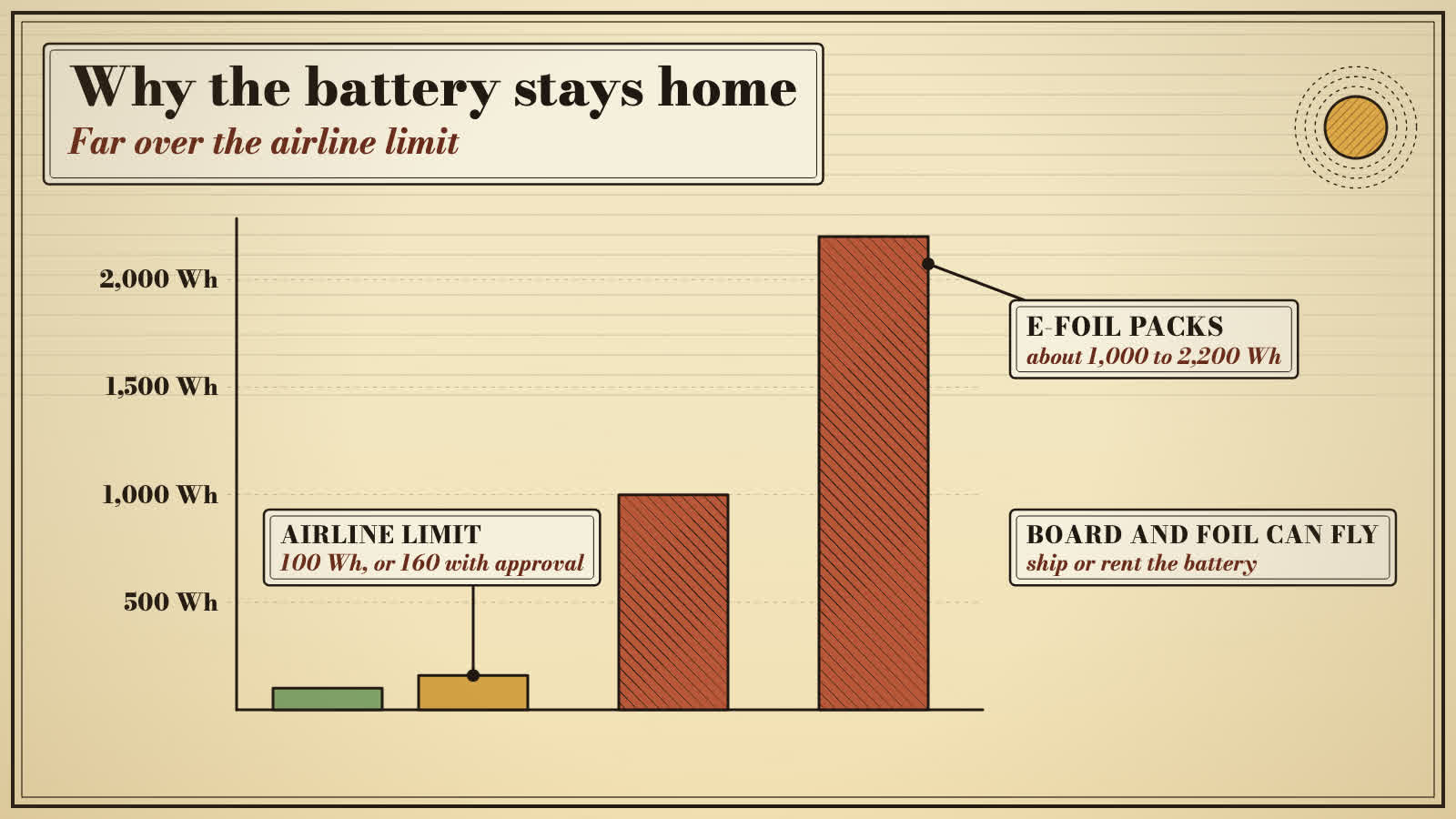
Airlines follow watt-hour (Wh) limits for lithium-ion batteries. IATA, the airline trade body, gives these general rules:5
- Up to 100 Wh: generally allowed in carry-on.
- 100 to 160 Wh: may be allowed with airline approval.
- Over 160 Wh: usually not allowed on passenger aircraft.
Spare batteries must go in your carry-on, never in checked bags, and damaged or swollen batteries should not travel at all.5
An e-foil battery is many times bigger than the top limit. Fliteboard says high-capacity e-foil batteries run from about 1,500 Wh to over 2,000 Wh. As of November 2026, Lift lists 1.0 kWh (1,000 Wh) and 2.2 kWh (2,200 Wh) packs.6,7
The brands say the same thing:
- Fliteboard: its Flitecells can't go on passenger aircraft because of their dangerous goods class. They must go by cargo air or sea freight with a safety data sheet (MSDS).1
- Lift: its batteries generally can't fly as normal checked or carry-on bags. Contact Lift support before you travel for your battery's transport papers.4
Always check with the airline you fly. Foil Drive notes that the operating airline has the final say, and one airline's approval does not bind another.8
What can fly
The rest of the set can usually go as sports baggage. Foil Drive says motors and masts can usually travel with your sports gear, with the props off and connectors protected. It suggests putting foils, masts and props in checked bags, since sharp items may be taken at security. Check each airline's sports equipment rules, and use a strong padded bag.8,3
Your options for the battery
Ship it ahead. A lithium-ion battery shipped on its own is UN3480, a Class 9 dangerous good. Lift says to ship only through a certified dangerous goods shipper. Lift also suggests keeping a battery at a place you visit often.9,10,4
Rent at your destination. Fliteboard suggests renting a board or battery where you are going, and says it has more than 300 partners worldwide. Lift says renting or buying a battery locally works where there is an active foil scene. Check that the battery fits your board model first.3,4
Bring a foil assist travel battery. This option is for assist riders only. Foil Drive's MAX travel battery splits into three modules: two of 129.6 Wh and one of 97.2 Wh. Its SLIM travel battery splits into 81 Wh and 97.2 Wh modules. Two of the MAX modules sit in the 100 to 160 Wh band. Foil Drive says airline rules generally mean one MAX set per passenger, and you must contact your airline before you fly. The Travel Batteries are for assist mode only, not e-foiling.11
FAQ
Can you take an e-foil battery on a plane?
No, not on a passenger flight. IATA says batteries over 160 Wh usually aren't allowed on passenger aircraft, and Fliteboard says its batteries can't be carried on them.5,1
How do you ship an e-foil battery?
As dangerous goods cargo, through a certified shipper. Fliteboard says to send it by cargo air or sea freight with a safety data sheet.10,1
How much does an e-foil weigh?
A complete Fliteboard weighs 18 to 34 kg (40 to 75 lb), depending on board, battery and wing.1
Can I leave my e-foil battery in the car?
No. Lift says never to leave the battery in a parked car, because the heat can damage it.4
Keep learning
Sources
Facts checked against the sources below in November 2026.
- Fliteboard, FAQ fliteboard.com ↩
- MACkite, Foil Drive MAX battery guide mackiteboarding.com ↩
- Fliteboard, A guide to safely transporting and carrying your eFoil fliteboard.com ↩
- Lift Foils, Transporting, storing and traveling with your eFoil liftfoils.com ↩
- IATA, Batteries iata.org ↩
- Fliteboard, How long does an eFoil battery last fliteboard.com ↩
- Lift Foils liftfoils.com ↩
- Foil Drive Help, Airline travel with Foil Drive help.foildrive.com ↩
- Transport Canada, Transporting batteries tc.canada.ca ↩
- Lift Foils, Battery safety and storage support.liftfoils.com ↩
- Foil Drive Help, MAX and SLIM travel battery guide help.foildrive.com ↩