 Foilopedia
Disciplines · Wind-powered
Windsurf foiling: what it is and how it works
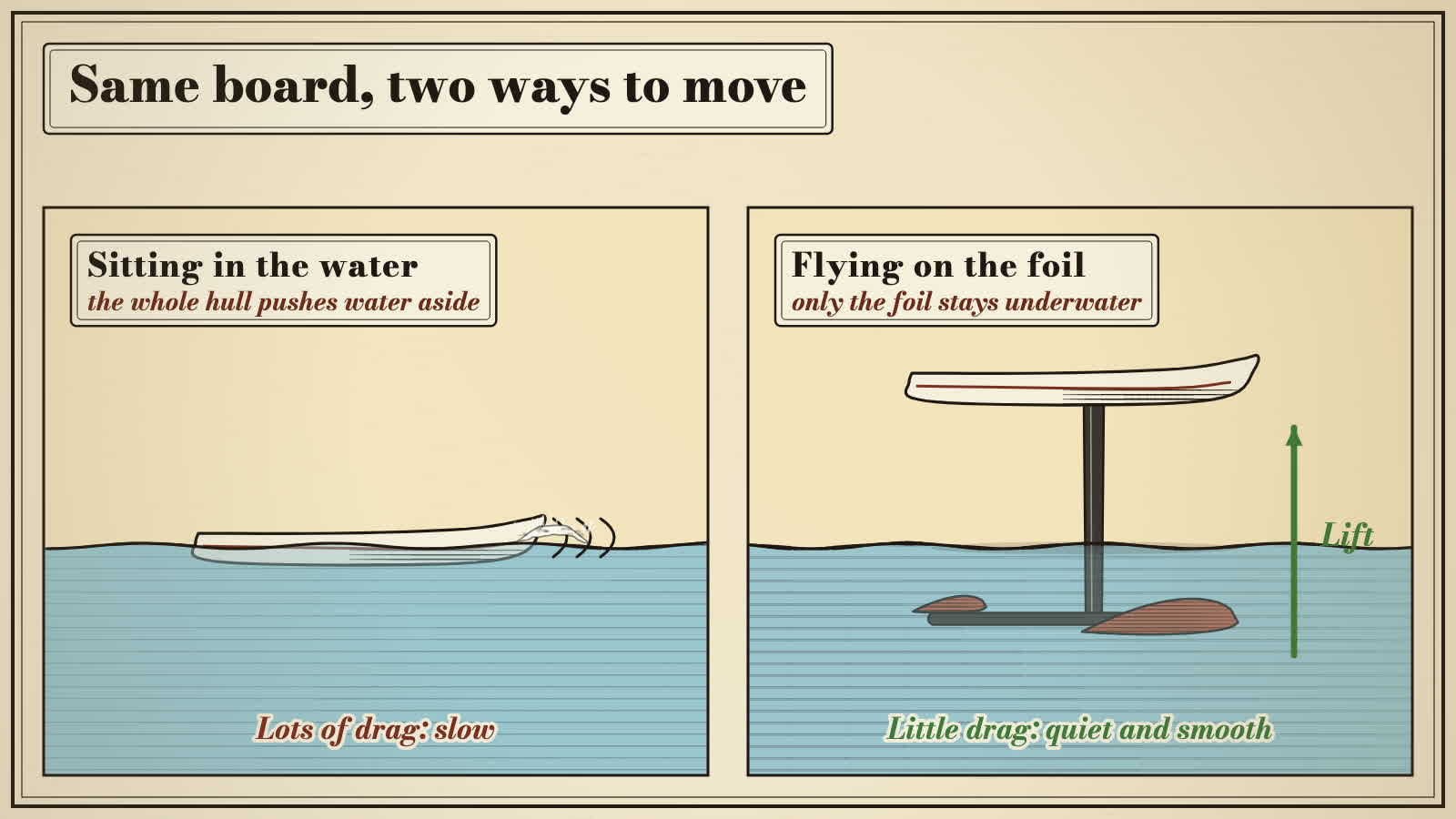
Windsurf foiling is windsurfing on a board that has a hydrofoil underneath it instead of a normal fin. The sail, mast and boom are still joined to the board at the mast foot, and once you sail fast enough the foil lifts the whole board out of the water. Riders also call it wind foiling.
It is mainly a path for people who can already windsurf, and it now has its own Olympic class, the iQFOiL, which replaced the old RS:X windsurfer at the Paris 2024 Games.1
At a glance
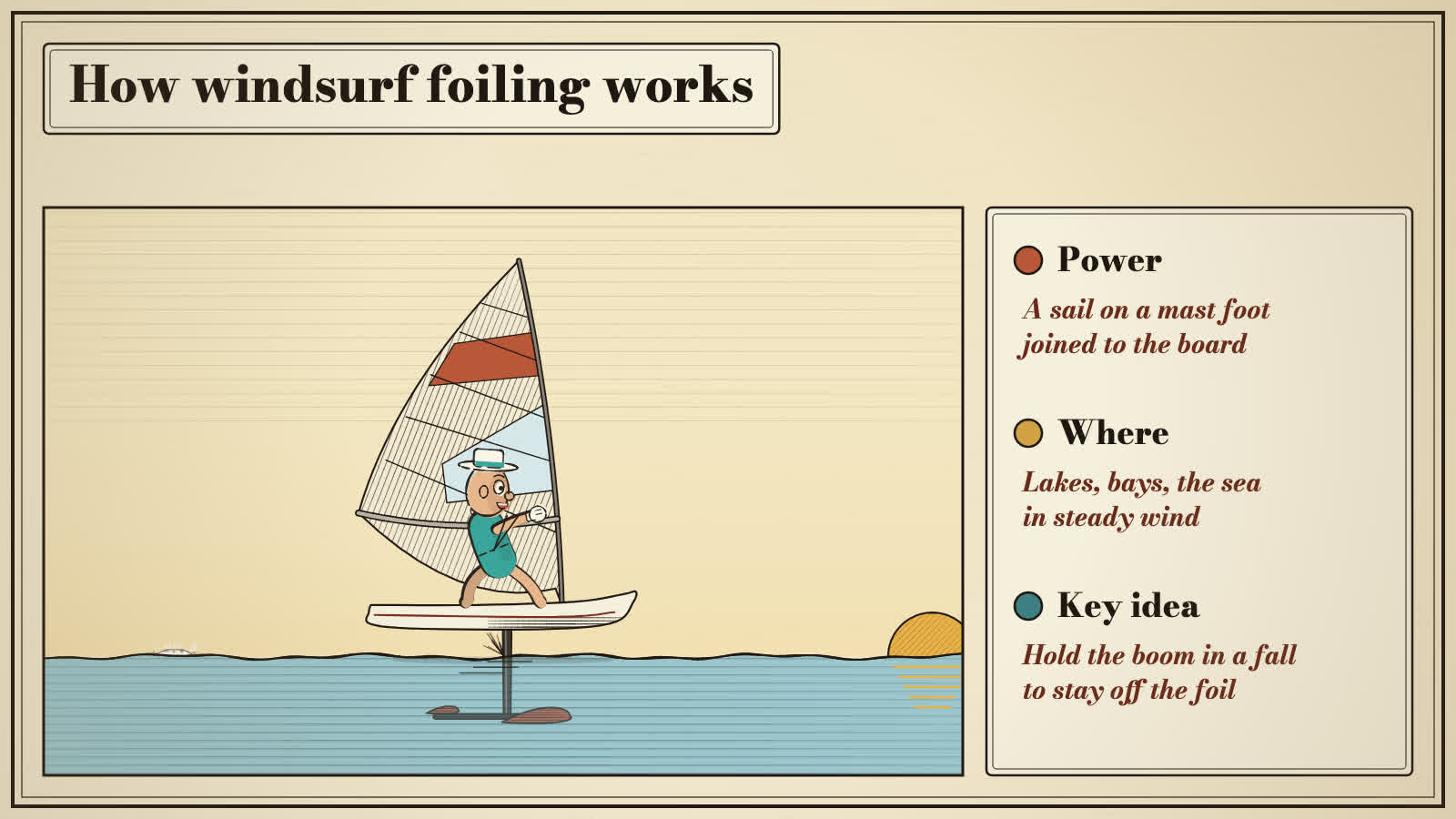
- Power: wind, in a sail joined to the board
- Where: lakes, bays and the sea, in steady wind
- Learn from zero? After you can windsurf
- Typical first step: a foil session at a windsurf center
- Gear to start: wide foil board, sail, foil
- Closest relatives: wing foiling, kite foiling
How it works
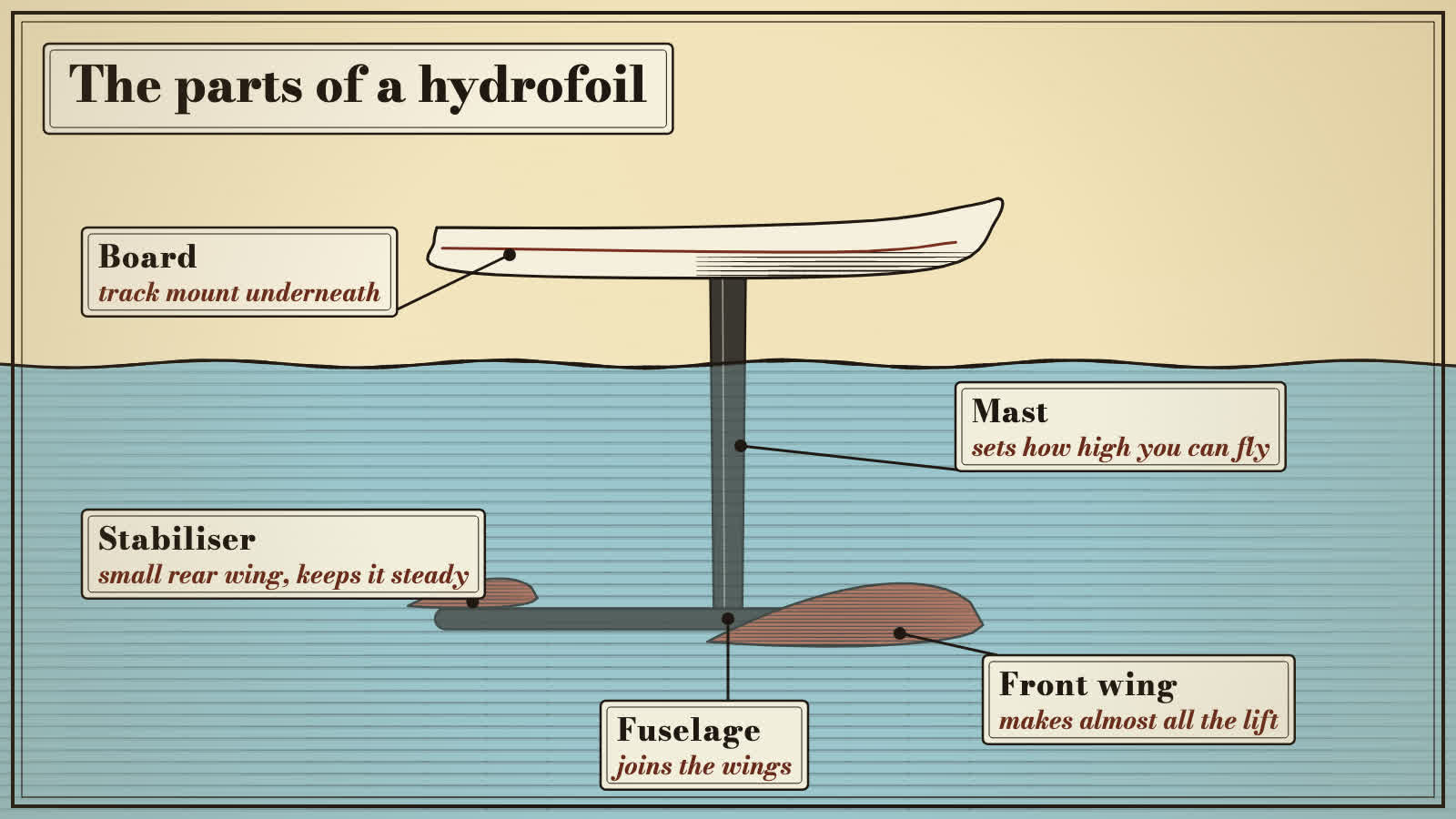
The foil under the board works the same way as in every other kind of foiling. If you want the basics of lift, height and the parts, read how a hydrofoil works.
What is special here is how the power reaches you. In windsurfing the sail is fixed to the board through the mast foot, a flexible joint that lets the rig tilt in every direction. The wind's push goes through the mast foot into the board, and through your arms and harness into your feet.
Getting up feels a lot like normal windsurfing at first. You sail along, build speed, then work your feet into position so you can press the board up onto the foil. Once it lifts, the less you move, the better. Starboard sums it up as "the stiller your body, the more successful."2
Because the board stops dragging through the water, a foil lets you sail when the wind is too light for normal windsurfing. Riders on light, playful setups often go out on days that are too light for waves or tricks.3
The gear
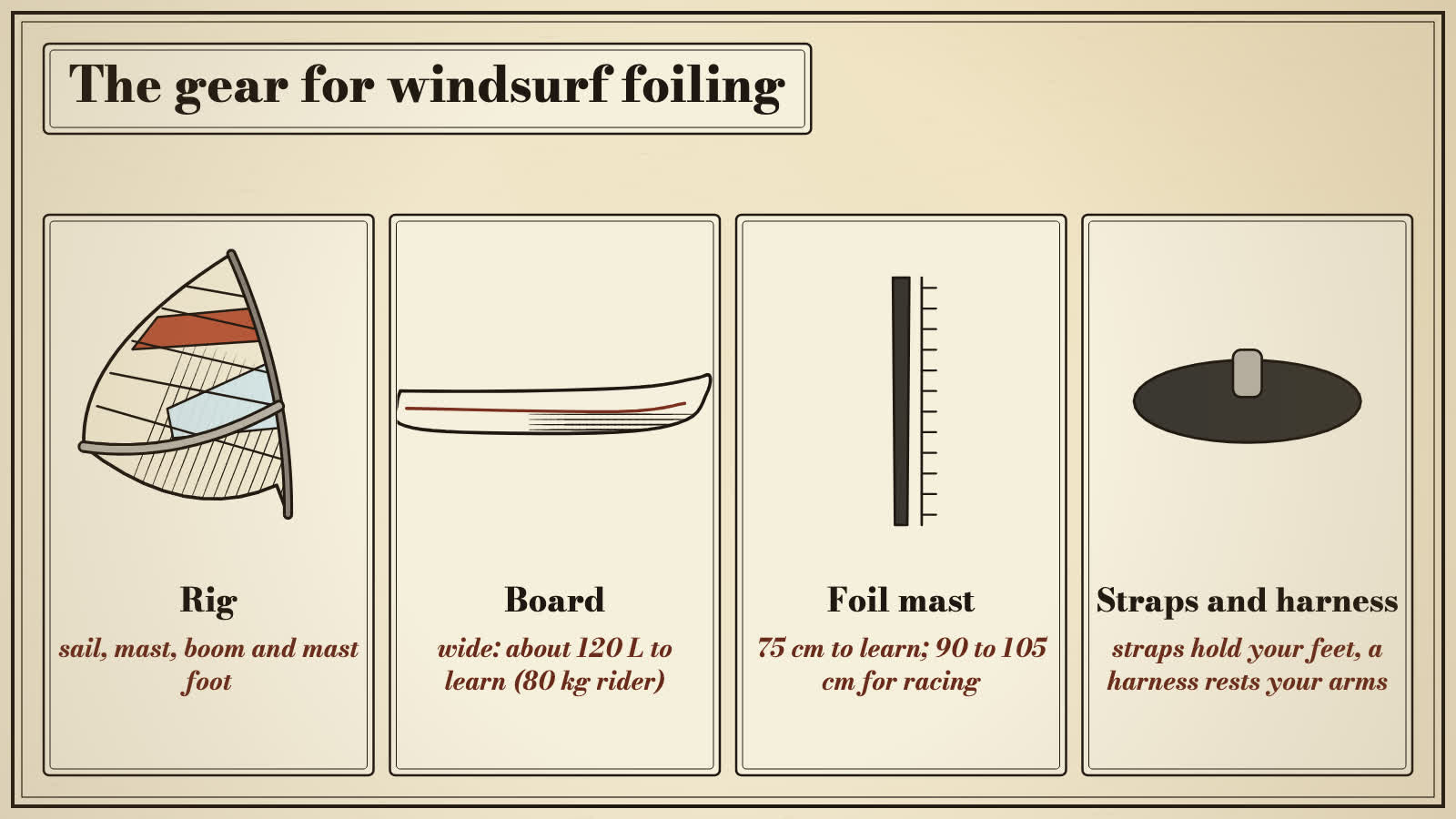
- Rig: the same parts as any windsurf rig: sail, mast, boom and mast foot. Foiling sails range from small, soft wave and freestyle sails to big racing sails with cambers (plastic pieces that hold the sail's curve).3
- Board: a wide, stable board with a strong foil mount. For learning, go wide: SURF magazine suggests about 120 liters and 75 to 85 cm (30 to 33 in) wide for an 80 kg (176 lb) rider.4
- Foil: race foils have long masts, about 90 to 105 cm (3 to 3.5 ft) for freerace.3
- Mast for learning: learners usually start shorter; SURF magazine calls 75 cm (about 30 in) a good universal size for beginners. A shorter mast keeps flights low and lets you ride in shallower water.4
- Straps and harness: straps hold your feet against the sail's sideways pull, and a harness rests your arms.
Words you'll hear
- Mast foot: the joint that connects the rig to the board.
- Foil ready: a board with a reinforced box that can take a foil instead of a fin.
- Deep tuttle: a common type of box that the foil mast screws into.
- Harness lines: loops on the boom that you hook your harness onto.
- Foilstyle and freerace: a playful, light-wind style on smaller sails, and a faster style on big sails and long masts.
- iQFOiL: the Olympic windsurf foil class.
How it differs from other kinds of foiling
Windsurf foiling vs wing foiling
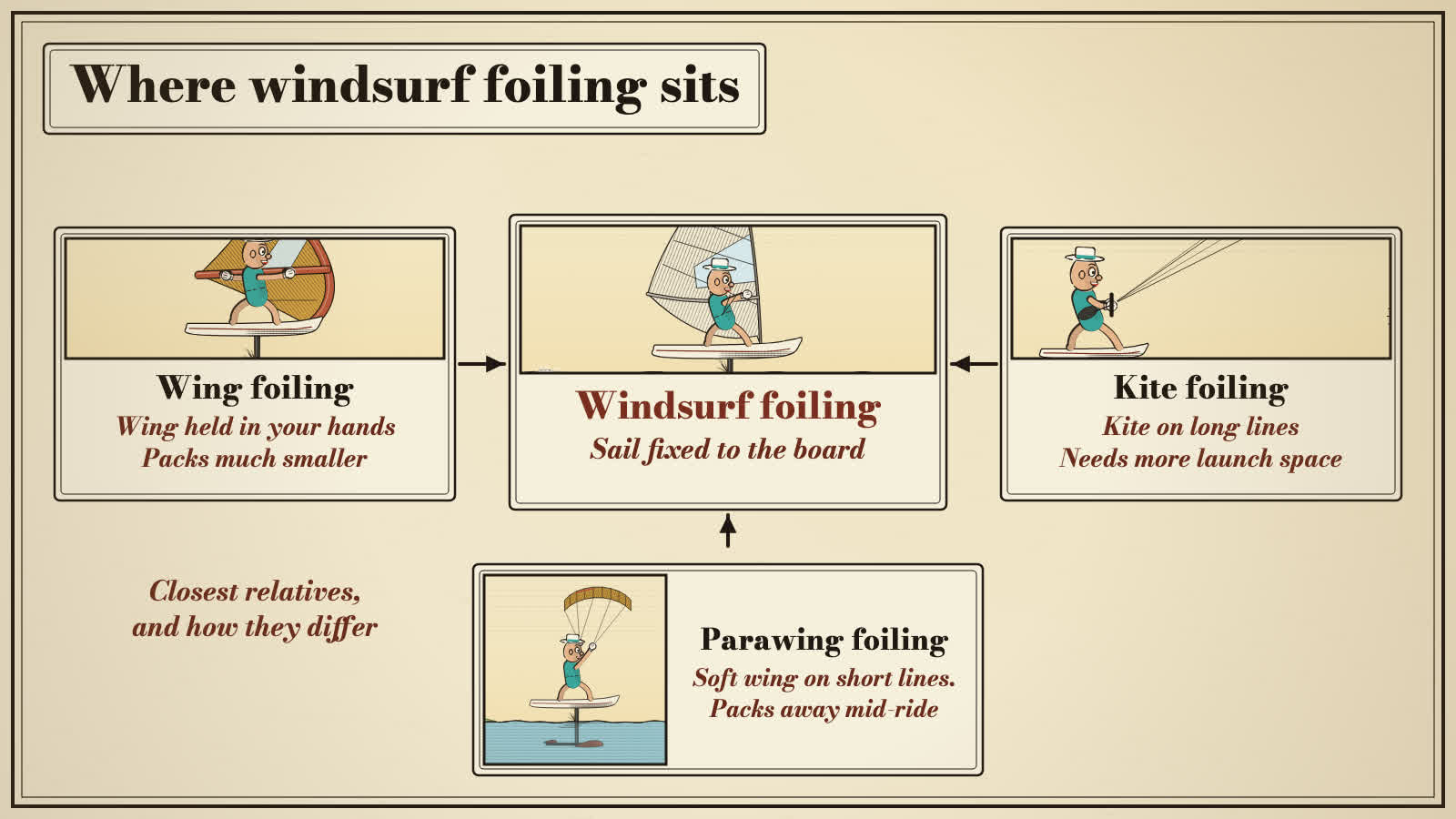
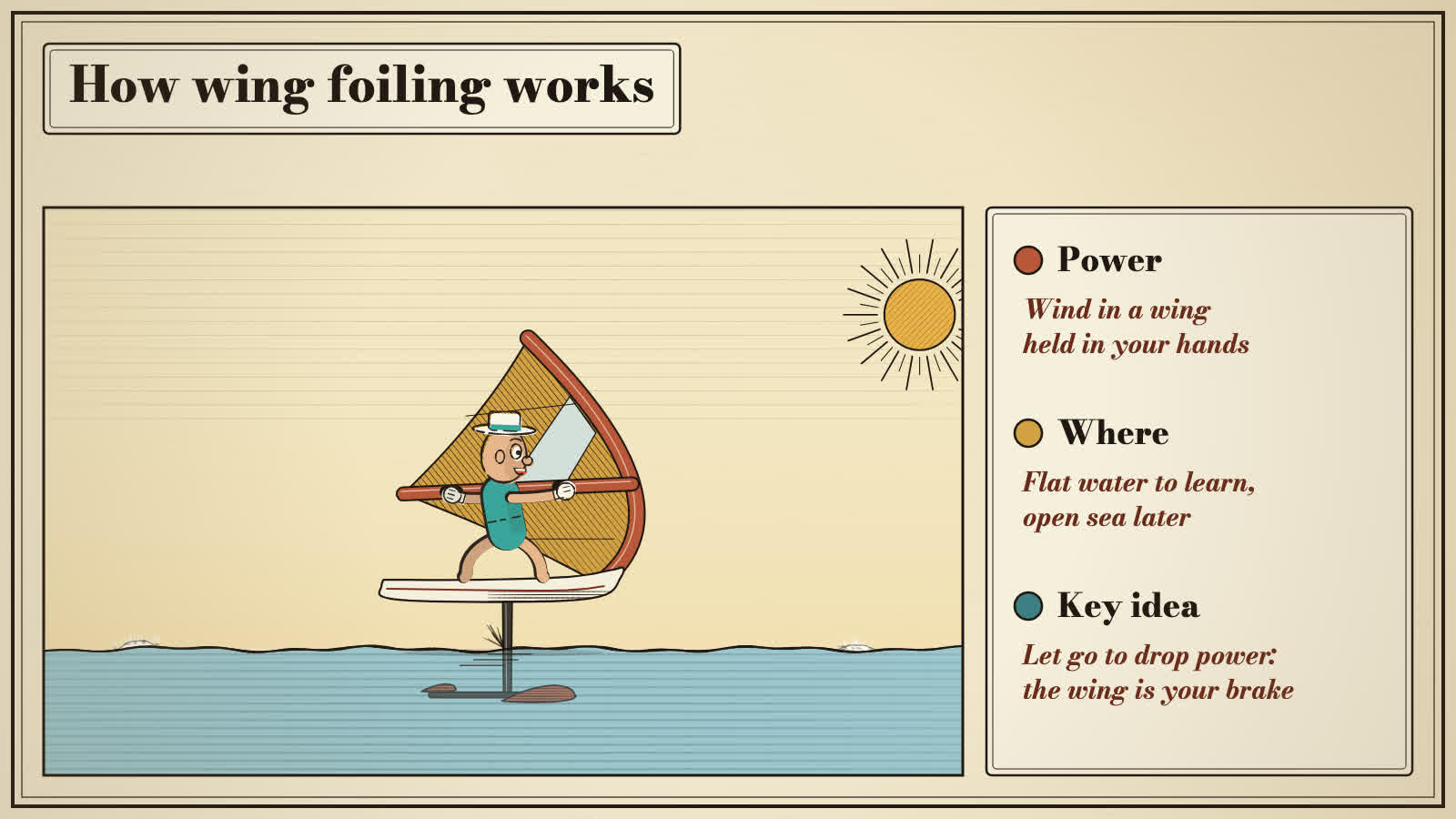
Both are pulled by the wind. In wing foiling you hold a light wing in your hands and nothing joins it to the board. In windsurf foiling the rig is fixed to the board, so you get more locked-in power and speed, but less freedom to move. A wing packs much smaller. If you have never windsurfed, a wing is usually the shorter road to your first flights.
Windsurf foiling vs kite foiling
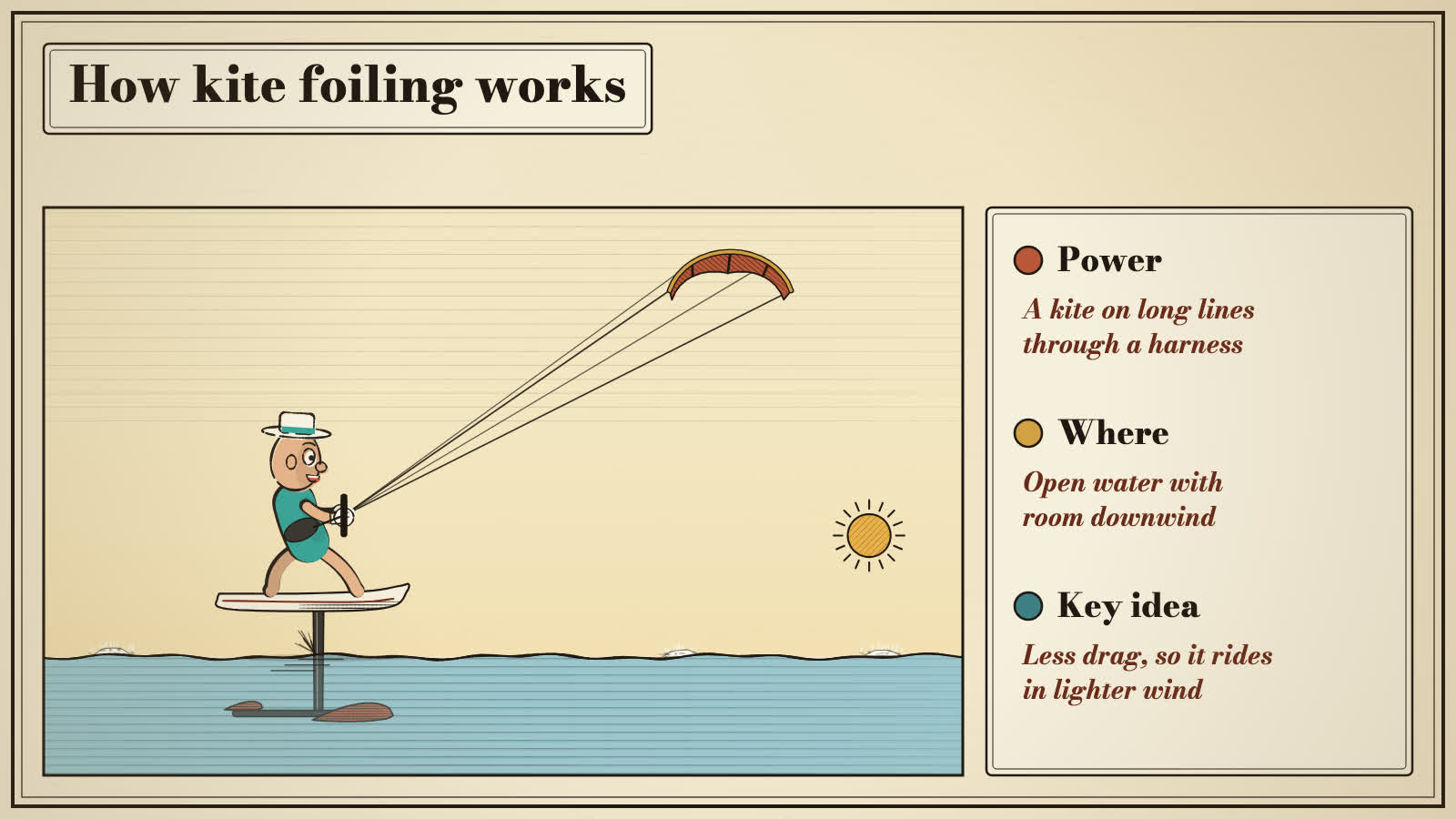
A kite flies on long lines above you, so kite foiling needs space to launch and land the kite. A windsurf rig has no lines, which makes launching from a small beach simpler, but the kit is heavier to carry. Both are Olympic board events, racing at Belmont Shore in Long Beach at the 2028 Los Angeles Olympics (LA28).5
Who it suits
A good fit if you:
- already windsurf and want more fun on light-wind days
- live near a lake or bay where the wind is often too light for normal windsurfing
- like the idea of racing
Probably not your first foil sport if:
- you have never windsurfed (learn that first, or start with a wing)
- you want kit that fits in a small car or a backpack
- you mostly want to ride waves, where a wing or kite feels more playful
Getting started: lessons, renting, buying
Lesson or not? If you can already windsurf, a session with a windsurf center that offers foil gear is the easiest way in. If you can't windsurf yet, take a normal windsurf course first. The foil sits on top of those skills.
Where to find one. Windsurf centers on lakes and coasts. Ask whether they rent foil-ready boards and foils.
Rent or buy? Rent first. Foil gear is a big step up in cost from a fin, so try a couple of setups before you spend money.
Can you use your own board? Maybe: see the first question in the FAQ below.
What to buy first. If you already own sails, the foil and a foil-ready board are the new parts. A smaller, soft sail is often easier to start on than your biggest race sail.
What your first sessions look like. Expect short hops at first, with the board lifting and dropping back down as you find the balance point. Starboard suggests trying your first flights without hooking into the harness lines, then hooking in once you can control the foil.2
Safety notes
The basics are the same in every kind of foiling: read our foil safety guide.
On a windsurf foil, add these:
- Hold on to the boom when you crash. Our general rule in foil safety is to let go early, and windsurf foiling is the exception. The rig is fixed to the board, so holding the boom keeps your body above and away from the foil instead of falling onto it.2
- Stay unhooked from the harness while you learn. A hooked-in catapult throws you forward over the rig, toward the board and foil. Unhooked, you can sheet out or let the sail go before it pulls you over. Keep your hands on the boom.
- Don't kick the foil when you are in the water next to the board. Foil edges can be sharp.2
- Mind the depth. Even a learner's mast reaches much deeper than a fin, so sail out to deep enough water before you try to fly.
Not sure this is the one? Compare every kind on what is foiling.
FAQ
Can you put a foil on a normal windsurf board?
Only if it has a fin box marked "foil ready," which means it is reinforced for a foil. Wide freeride or freerace boards with that box, or formula and slalom racing boards at least 80 cm (31 in) wide, can work. Many older boards can't, so check with the maker first.3
Is windsurf foiling easier than wing foiling?
For a windsurfer, it often is, because the rig, harness and straps already feel familiar. For someone new to wind sports, wing foiling is usually the easier way in, because there is less kit to learn.
What size sail do you need for windsurf foiling?
It depends on the style. Playful foilstyle setups use about 4.2 to 6.5 m² (45 to 70 sq ft) sails, while freerace setups use big sails of about 6 to 9 m² (65 to 97 sq ft).3
Do I need to windsurf before I foil?
Yes. You should be able to sail along comfortably first, because getting onto the foil starts from normal sailing. If you have never windsurfed, learn that first or try a wing instead.
Keep learning
Sources
Facts checked against the sources below in November 2026.
- World Sailing, What is an iQFOiL in Olympic sailing paris2024.sailing.org ↩
- Starboard, How to foil: master your first flight star-board.com ↩
- SURF magazine, Foil basics for foil windsurfing surf-magazin.de ↩
- SURF magazine, Buying advice for foil beginners surf-magazin.de ↩
- World Sailing, LA28 Olympic sailing event program sailing.org ↩
Also used:
- Fernhurst Books, How foils work: https://fernhurstbooks.com/knowledge_centre/62/how_foils_work_on_foiling_dinghies